

Art School – Studio 17 and the Practice of Staying Together
Podcast: Play in new window | Download
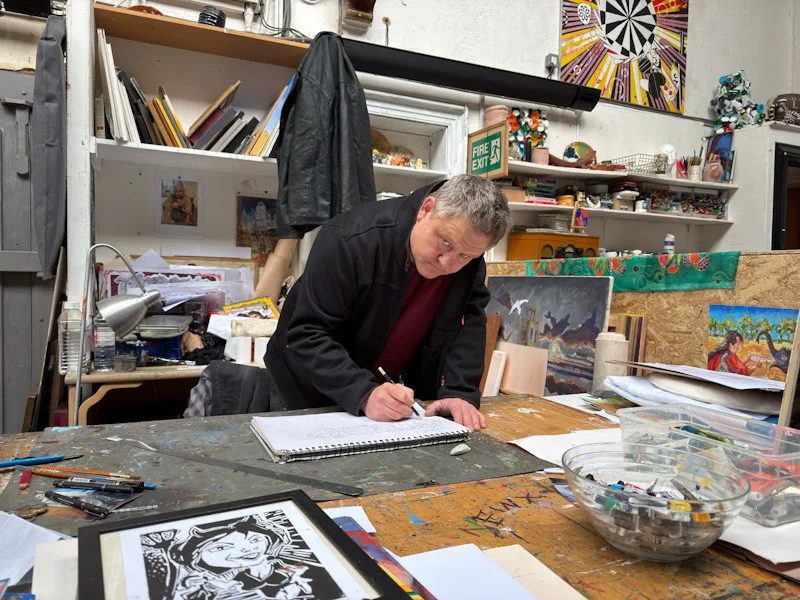
There is a particular kind of space that does not announce itself. It is not defined by its walls, nor by the tools arranged across its surfaces, nor even by the works that accumulate over time. It is defined instead by a continuity of presence. Studio 17, as described in this conversation, is one such space. It is less a studio in the conventional sense than a long-held conversation, unfolding across decades, carried by those who have entered, left, returned, and remained.
What emerges from the voices of the artists is not a singular narrative of artistic production, but a shared condition of being alongside others. The studio offers proximity. Not only physical proximity, but a kind of attentiveness. Artists speak of sensing one another, adjusting to rhythms that are not imposed but felt. There are moments of quiet, moments of conversation, moments of withdrawal and return. The space holds these variations without demanding resolution.
This rhythm is not incidental. It is cultivated through time. Over thirty years, the studio has sustained a collective identity that is neither fixed nor fragile. It persists because it allows for difference. Artists arrive with different practices, different histories, and different levels of confidence. Some return to art after long absences. Others begin tentatively, discovering their voice in relation to others. The collective does not erase individuality; it provides the conditions in which individuality can emerge.
There is a practical dimension to this. Materials are shared. Advice is given when asked. Work is seen, responded to, and occasionally challenged. Yet what is described goes beyond collaboration in any formal sense. It is closer to mutual recognition. The presence of others becomes a form of support that is not always verbalised. It is there in the background, shaping the atmosphere of the work itself.
 For some, this shared environment becomes transformative. Confidence develops not through instruction alone, but through participation. To be accepted within the space, to exhibit alongside others, to contribute to a shared history, alters how one understands oneself as an artist. The studio becomes a site of transition, where private interest becomes public expression, and where personal practice acquires a social dimension.
The longevity of Studio 17 suggests that this form of collective life answers a deeper need. It offers continuity in a field often marked by precarity and isolation. Artists describe the difficulty of sustaining practice alone, the challenges of motivation, the uncertainty of recognition. Against this, the studio provides a steady ground. It is not immune to change. Members pass away. New members arrive. The character of the space shifts. Yet, the underlying structure remains intact, carried forward by those who continue to gather.
The retrospective exhibition, marking thirty years, becomes more than a display of work. It is an act of remembering. Works by those no longer present are held alongside those of current members. The exhibition does not resolve the passage of time; it makes it visible. In doing so, it reinforces the sense that the studio is not simply a place of production, but a repository of shared experience.
What is striking is the absence of instrumental language. The artists do not speak primarily of career progression, market success, or institutional validation. These concerns are present, but they are secondary. The emphasis falls instead on enjoyment, on learning, on being part of something that endures. Art is described as a way of inhabiting time, of finding meaning in the act of making, and of connecting with others through that act.
In this sense, Studio 17 resembles an art school that has escaped its formal boundaries. It retains the essential qualities of a learning environment, but without the temporal limits or hierarchical structures that often define institutional education. Learning continues indefinitely, shaped by experience rather than curriculum. The collective becomes both teacher and archive.
To listen to these accounts is to encounter a different model of artistic life. One in which the shared space is not merely supportive, but constitutive. It shapes the work, the artist, and the relationships between them. It suggests that the conditions in which art is made are inseparable from the art itself. And that sometimes, what endures is not the individual work, but the space that makes such work possible.
Art School, as a series, begins here. Not with theory, but with practice. Not with abstraction, but with the lived experience of artists who have chosen, over many years, to remain in proximity to one another. The lesson is not stated directly. It is held in the space between them.


